
Solar PV Panels
Solar panels in Liverpool generate your own electricity all year round: we fit MCS-certified solar PV across the city and Merseyside, cutting your bills and your carbon footprint, with battery options to store what you make.




Get your fixed price
A free survey and a clear fixed quote for your solar PV panels. No pressure, no jargon.
Or call 0151 440 2000 · Gas Safe reg. 541116
Done properly, by a local team
Lower energy bills
Use the free electricity you generate and buy less from the grid.
MCS-certified installs
Fitted to standard so you qualify for available export payments.
Add a battery
Store daytime generation to use in the evening and get even more from your panels. We fit the Fox ESS range — see battery storage.
Read more →Are solar panels worth it in Liverpool?
For most suitable roofs, yes, and the numbers are public. The European Commission's PVGIS model puts a 4 kWp south-facing array at a 35-degree pitch in Liverpool at about 3,870 kWh a year, and an east- or west-facing one at roughly three-quarters of that. Whether that is worth it to you depends on three things: how much of the output you use in the house rather than export, whether a battery moves midday generation into the evening, and how long you plan to stay. Solar cuts the electricity bill, not the gas bill. Installation of domestic solar carries 0 per cent VAT until 31 March 2027. We put the modelled annual figure for your own roof in writing before you commit, and the sections below explain how it is worked out.
Liverpool's terraces, semis and conservation areas
Liverpool has the largest proportion of terraced housing of any major English city, and a terrace roof faces whichever way the street runs, so plenty of city roofs are east-west rather than south. That still works: the two slopes spread generation across morning and late afternoon. The interwar semis of Childwall often have a clean rear slope at a good pitch, and the bigger houses of Woolton can take a larger array. Planning matters more here than in most cities. Liverpool City Council lists 36 conservation areas covering around nine per cent of the city, including Woolton Village. Roof panels on a house are usually permitted development, but in a conservation area they cannot go on a wall fronting a highway, and a listed building needs consent. We check before we quote. Further out, our local pages cover the Wirral, Southport, St Helens and Warrington.
Does solar actually work this far north?
Yes, and by a wider margin than most people expect. Panels run on daylight rather than heat, so they still generate on an overcast Merseyside day from diffuse light, just at a reduced rate. They also lose a little output as they warm up, which is why a bright, cool April day can beat a muggy one in August. The European Commission's PVGIS model puts a 4 kWp south-facing array at a 35-degree pitch in Liverpool at roughly 3,870 kWh a year. The same system modelled in Brighton comes out near 4,640 kWh. The North West penalty is real, but it is around 15 to 20 per cent, not the half that people assume. Up the coast, the same array modelled in Southport comes out at about 4,090 kWh; inland, Warrington and St Helens sit around 3,750 kWh. The bigger factor is seasonality rather than latitude. That Liverpool array is modelled at about 506 kWh in May and about 116 kWh in December. Winter output is a small fraction of summer output, and that shapes how you should think about batteries, export and payback.
Orientation, pitch and shading on a Merseyside roof
A due-south slope at 30 to 40 degrees is the best case, and plenty of 1930s semis across the Wirral, Crosby and Childwall have a pitch in that range — though whether a particular roof faces south depends on how the street runs, which is what the survey establishes. Liverpool's Victorian and Edwardian terraces often have no choice in the matter: their slopes run east and west, so a row along a north-south street gives you one morning roof and one afternoon roof. That is not a reason to walk away. PVGIS models the same 4 kWp array facing east in Liverpool at around 2,990 kWh a year, roughly 23 per cent below south. An east or west split spreads generation across breakfast and teatime, which often matches household demand better than a single midday peak, so you may use a higher share of a smaller total. Shading usually costs more than orientation. Chimney stacks, dormers, aerials, neighbouring gables and mature trees all take output, and on a plain string inverter, shade on one panel pulls down the output of the whole string, not just that panel. Power optimisers or micro-inverters limit that, at extra cost.
System size: what kWp means and what will fit
kWp is the peak rating of the array under standard test conditions, not what you will see on a Tuesday in November. Most panels sold for UK homes in 2026 are rated between roughly 400 W and 500 W and measure about 1.7 m by 1.1 m, so ten panels give you somewhere around 4 to 5 kWp and need about 19 square metres of clear, unshaded slope. A typical semi takes eight to fourteen panels; a two-up two-down terrace often takes fewer. Size the system to the electricity you actually use, not to the roof you have. Putting 8 kWp on a house that uses 2,800 kWh a year mainly means exporting the surplus at a lower rate than you pay to import it. An electric car, a heat pump or someone at home during the day changes that arithmetic. There is a grid limit as well. Where the total generation capacity at the property comes to more than 3.68 kW per phase — the solar inverter plus any battery inverter, counted together — the network operator has to approve the connection in advance under G99. At or below it, the installer simply notifies them within 28 days of commissioning under G98.
Batteries, self-consumption and why the split matters
Every unit you use yourself saves you the full import price. Every unit you export earns the export rate, which is normally lower. The share you use on site is therefore the single biggest lever on your return. Without storage, a household typically uses somewhere around 35 to 50 per cent of what the panels make, because generation peaks at midday while demand peaks morning and evening. A correctly sized battery, commonly 5 to 10 kWh for a family home, usually lifts that to somewhere around 70 to 85 per cent. Allow for roughly 10 per cent round-trip loss charging and discharging. Batteries do a second job that is easy to overlook. On a time-of-use tariff they can charge from the grid at a cheap overnight rate and cover the expensive evening peak, which keeps earning through December when the panels are contributing very little. Domestic battery storage carries 0 per cent VAT until 31 March 2027, including retrofits to an existing array. Note that the battery inverter counts towards the 3.68 kW per phase threshold alongside the solar inverter, so adding storage can move a job from notification to prior approval.
The Smart Export Guarantee, in plain terms
The Smart Export Guarantee is the scheme that pays you for electricity sent back to the grid. Licensed suppliers with 150,000 or more domestic customers must offer an export tariff, and the rate has to be above zero at all times. Beyond that, suppliers set their own rates, contract lengths and terms. Rates vary widely and change, so compare them when you come to sign up rather than trusting a figure written into a quote. Three practical points. Payment is not automatic: you apply to a supplier, and it need not be the one who sells you your electricity, though the highest headline rates are usually reserved for a supplier's own import customers. You need metering that reports half-hourly export — in practice a working smart meter your supplier can actually read for export — plus your export MPAN. And the installation must be certified under MCS or Flexi-Orb at the time it is commissioned, so registration for export is handled through an MCS-certified installer.
What a survey checks before anything is ordered
An array is a 25-year fixture, so the roof is assessed first: covering type, condition, remaining life, and whether slates or tiles are sound enough to lift and refit. If the covering is near the end of its life, renew it before the panels go on rather than paying to strip and refit later. Rafter size, spacing and condition are checked along with wind loading, which matters more on exposed coastal stretches of Sefton and the Wirral. Installed load is usually around 12 to 15 kg per square metre, comfortably less than the covering it sits on — natural slate runs roughly 25 to 40 kg per square metre and concrete tiles more again. Then the electrics: consumer unit capacity, earthing arrangement, cable route from loft to inverter, and where the inverter will live. The electrical work is notifiable under Part P of the Building Regulations and the roof structure has to satisfy Part A; a registered installer self-certifies the electrical side, so there is no separate application for you to make. The distribution network operator is involved either way, with approval needed in advance where total generation capacity exceeds 3.68 kW per phase. SP Energy Networks covers Merseyside, the Wirral and much of Cheshire; Electricity North West covers areas further north and east. Scaffolding access is confirmed at the same visit, which matters on terraces with narrow rear entries.
Realistic expectations, and what solar will not do
Solar cuts your electricity bill. It does not cut your gas bill. If heating and hot water come from a gas boiler, panels do nothing for that part of your energy use unless you add a diverter that sends surplus generation to the immersion element in a hot water cylinder, which is only possible if you have a cylinder rather than a combi. Output drops slightly each year as the panels age, and the inverter is normally the shortest-lived component in the system. The panels themselves ask very little: keep overhanging growth clear, and consider bird proofing if gulls or pigeons are a nuisance locally. Ask for the modelled annual generation in writing, with the assumptions behind it, and ask separately for the panel product warranty and the performance warranty, which are two different things. Installation of domestic solar carries 0 per cent VAT until 31 March 2027, after which it is due to return to 5 per cent. Finance is available, subject to status; see our finance page.
Simple, from quote to comfort
- 1
Free survey & fixed quote
We visit, assess your home and give a clear fixed price — no pressure, no jargon.
- 2
Pick a date that suits you
Choose a day that works. We confirm everything up front and answer any questions.
- 3
Tidy, Gas Safe install
Our engineers fit your system cleanly and safely — and leave your home spotless.
- 4
Aftercare & guarantee
You're covered by the manufacturer guarantee, with our local team a phone call away.
Related services
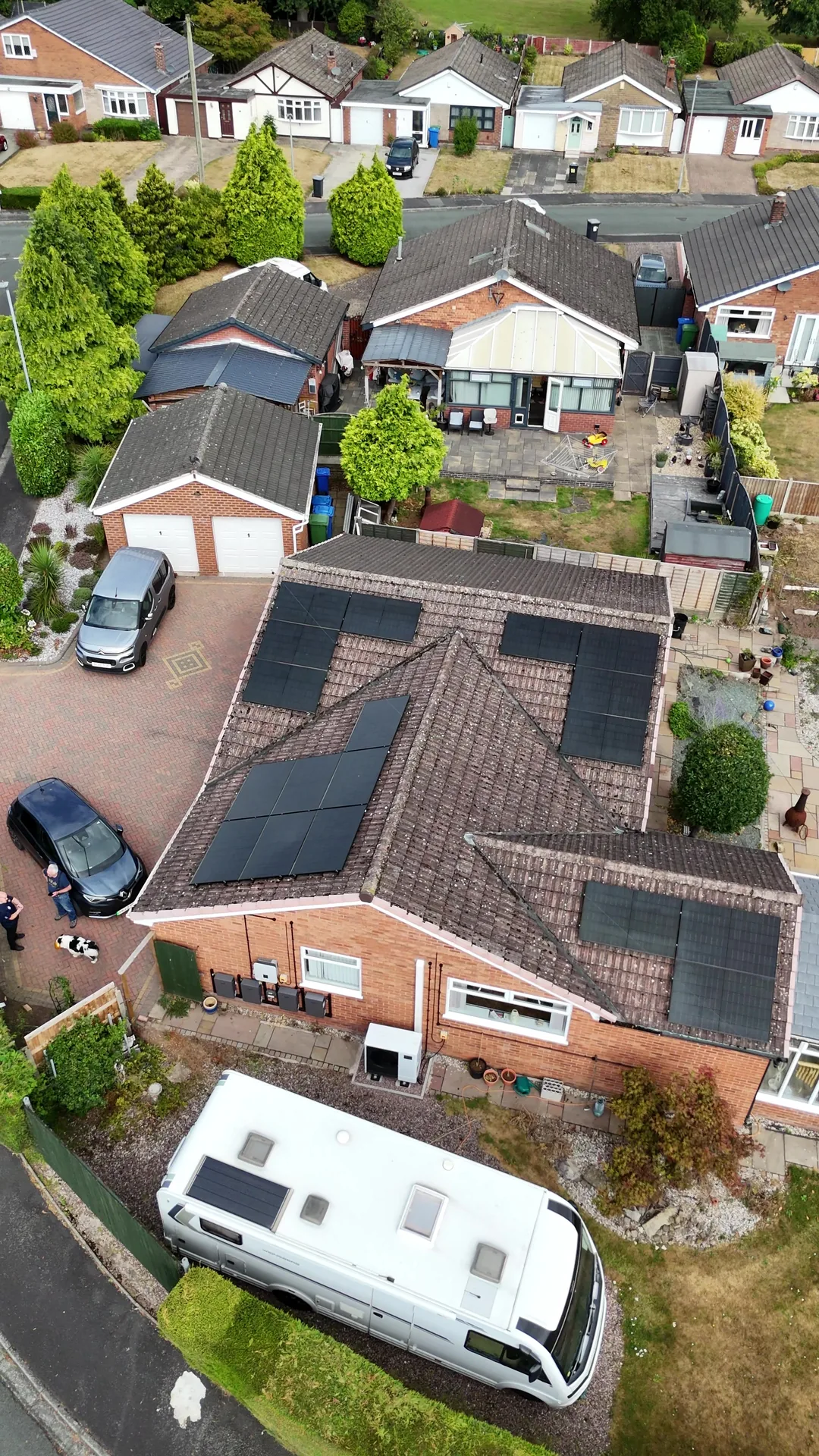
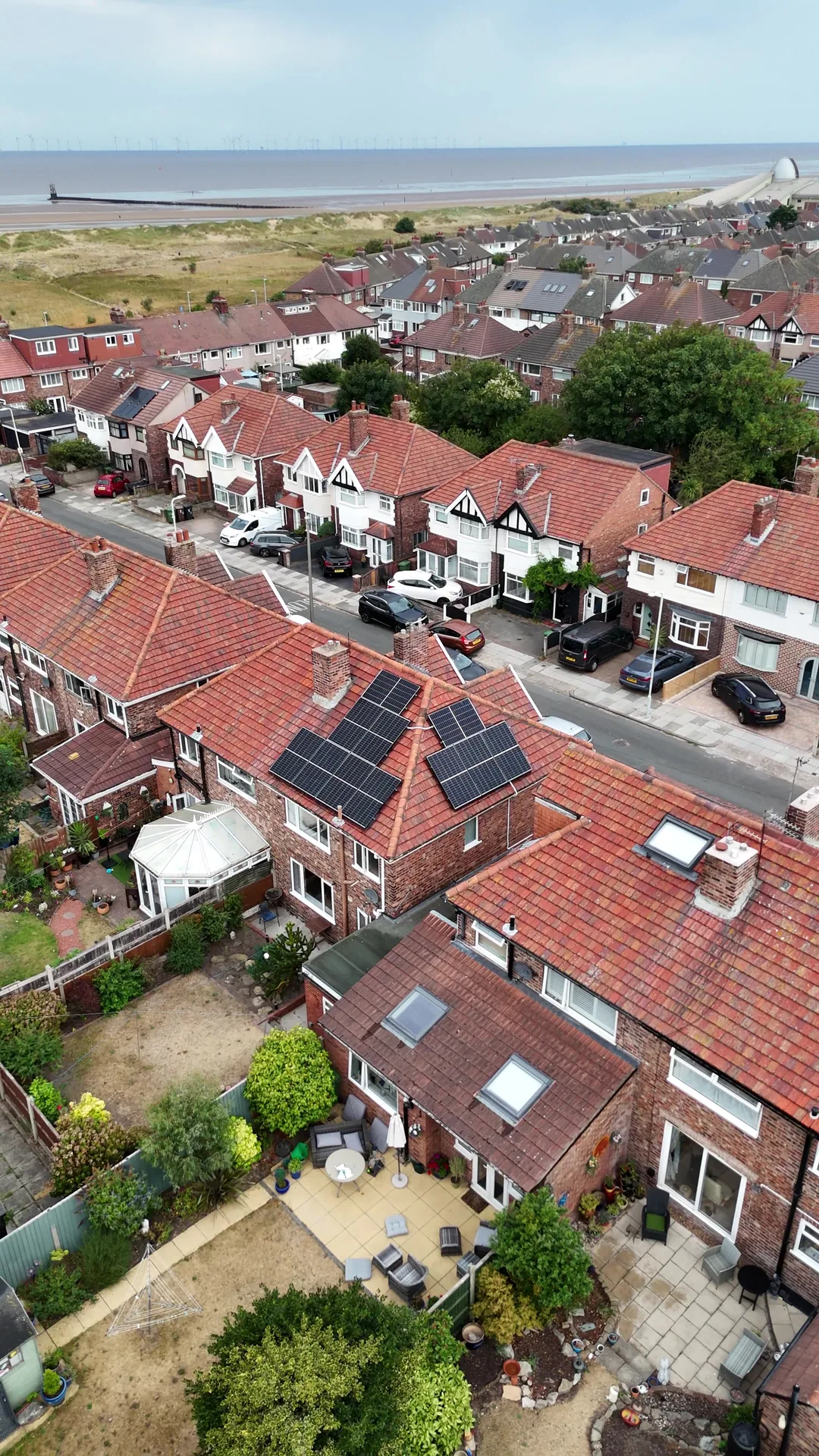
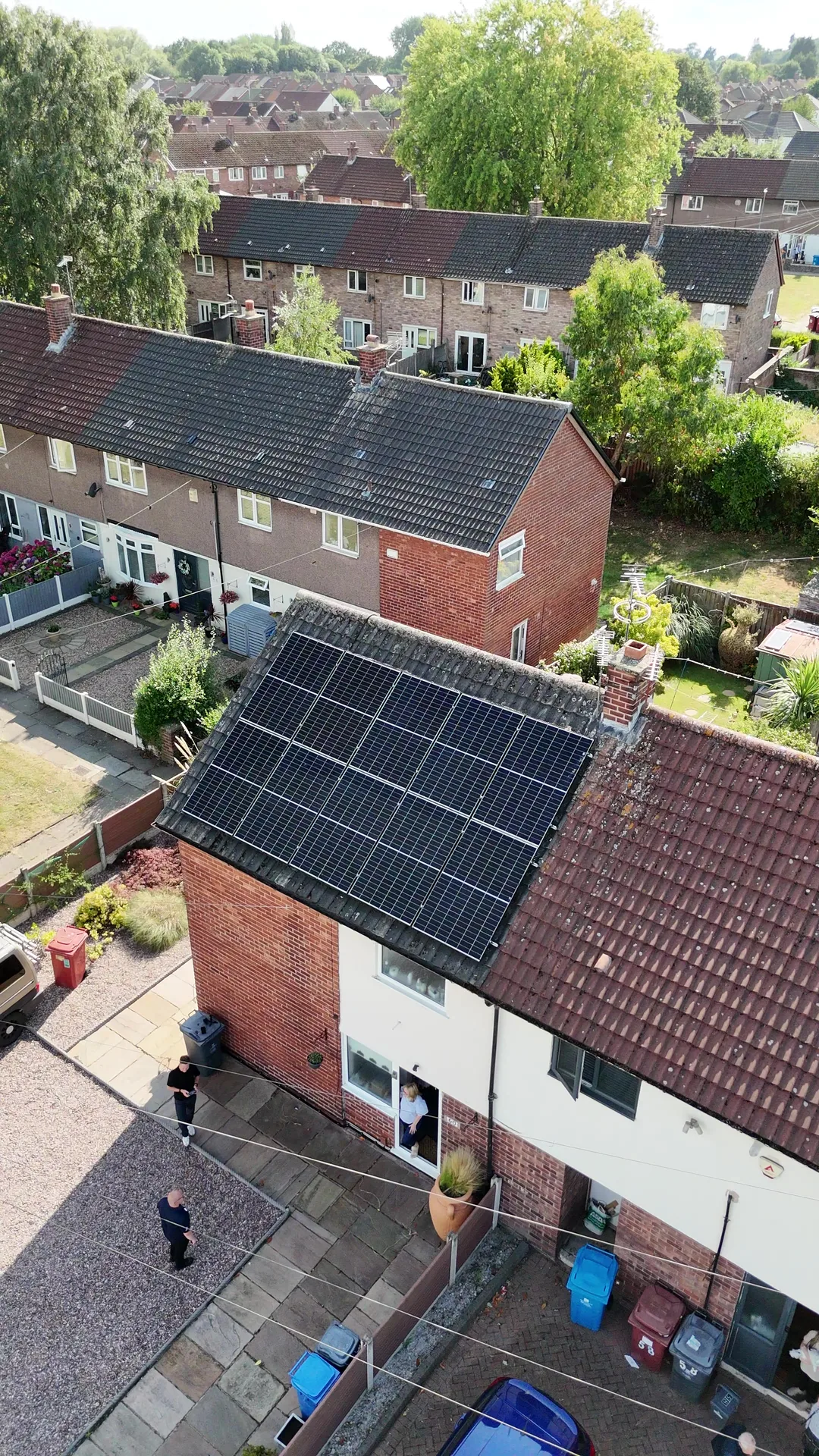
Recent installs, seen properly
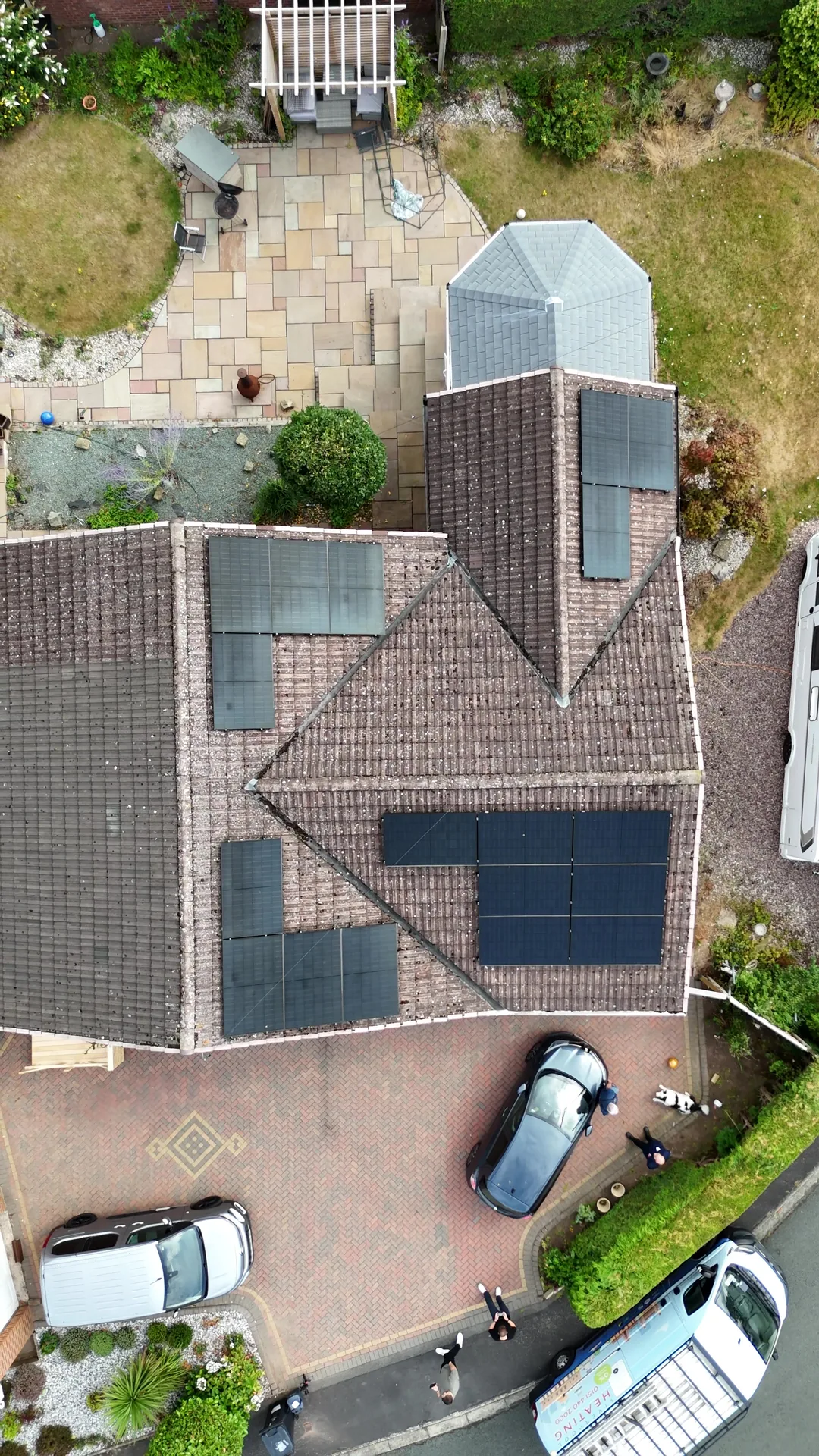
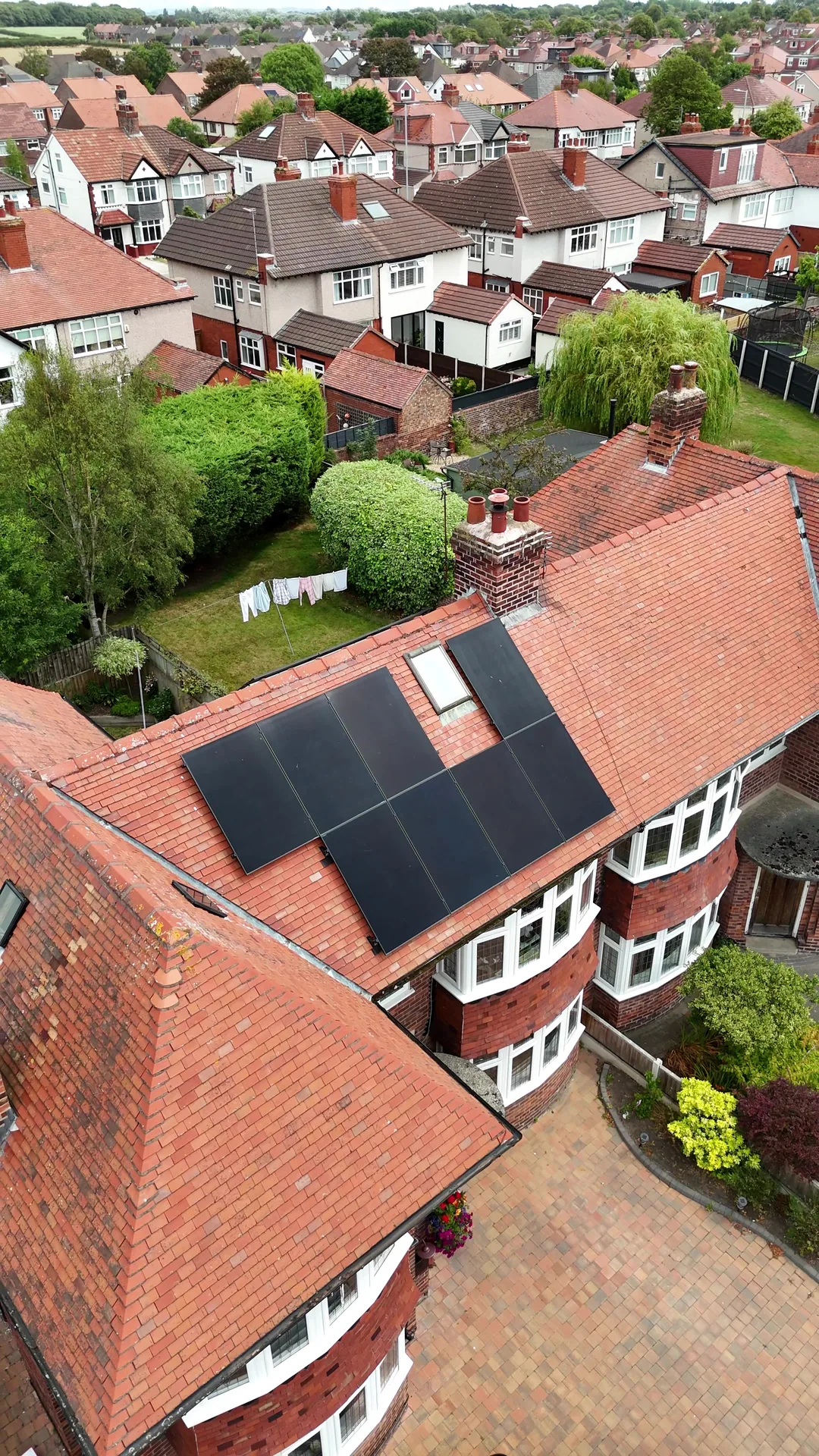
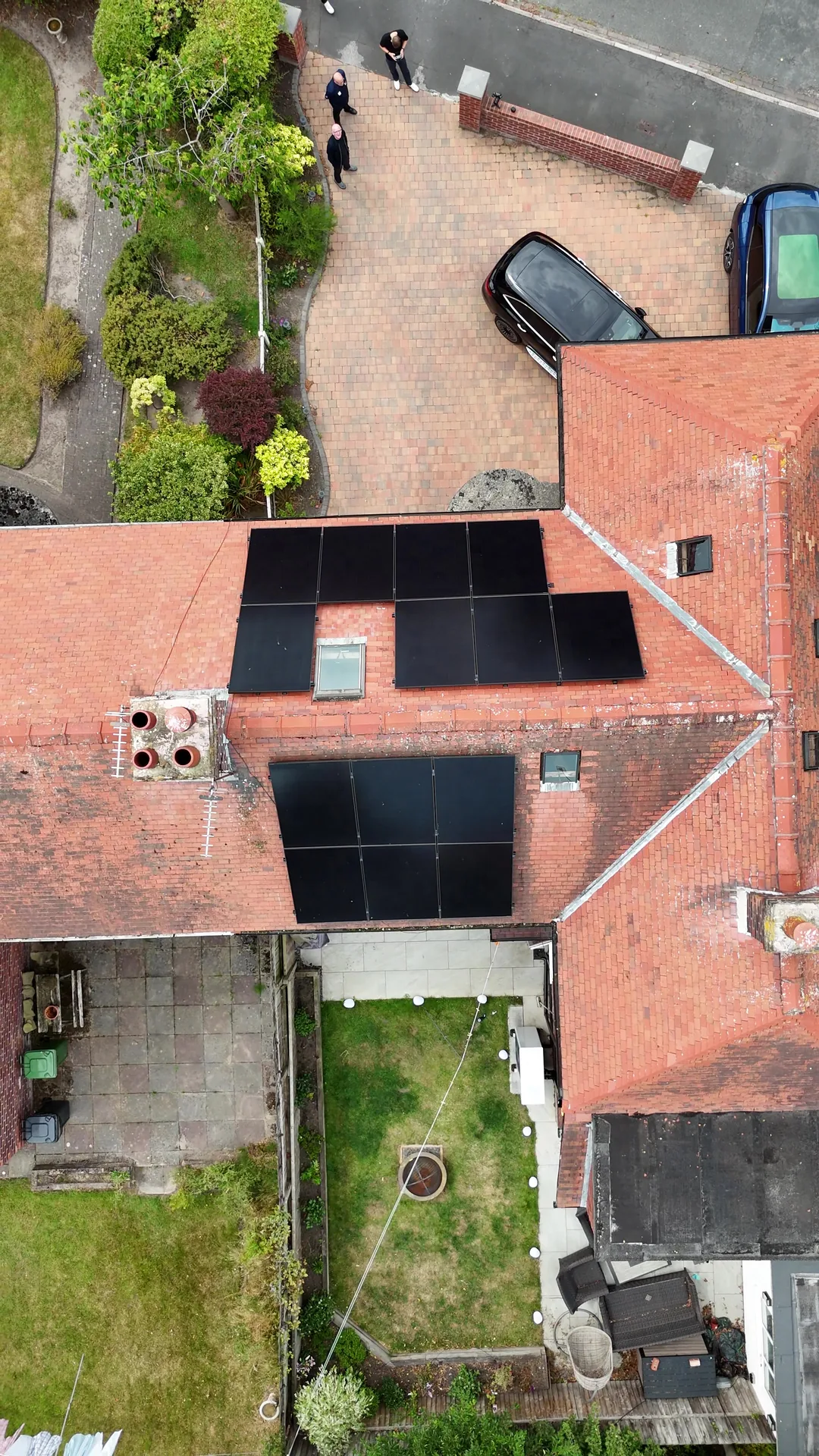
Our videographer flew over four jobs this summer. This is what a finished Liverpool Heating install looks like from above — real roofs, real panels, no stock photos.
Read about the four jobs →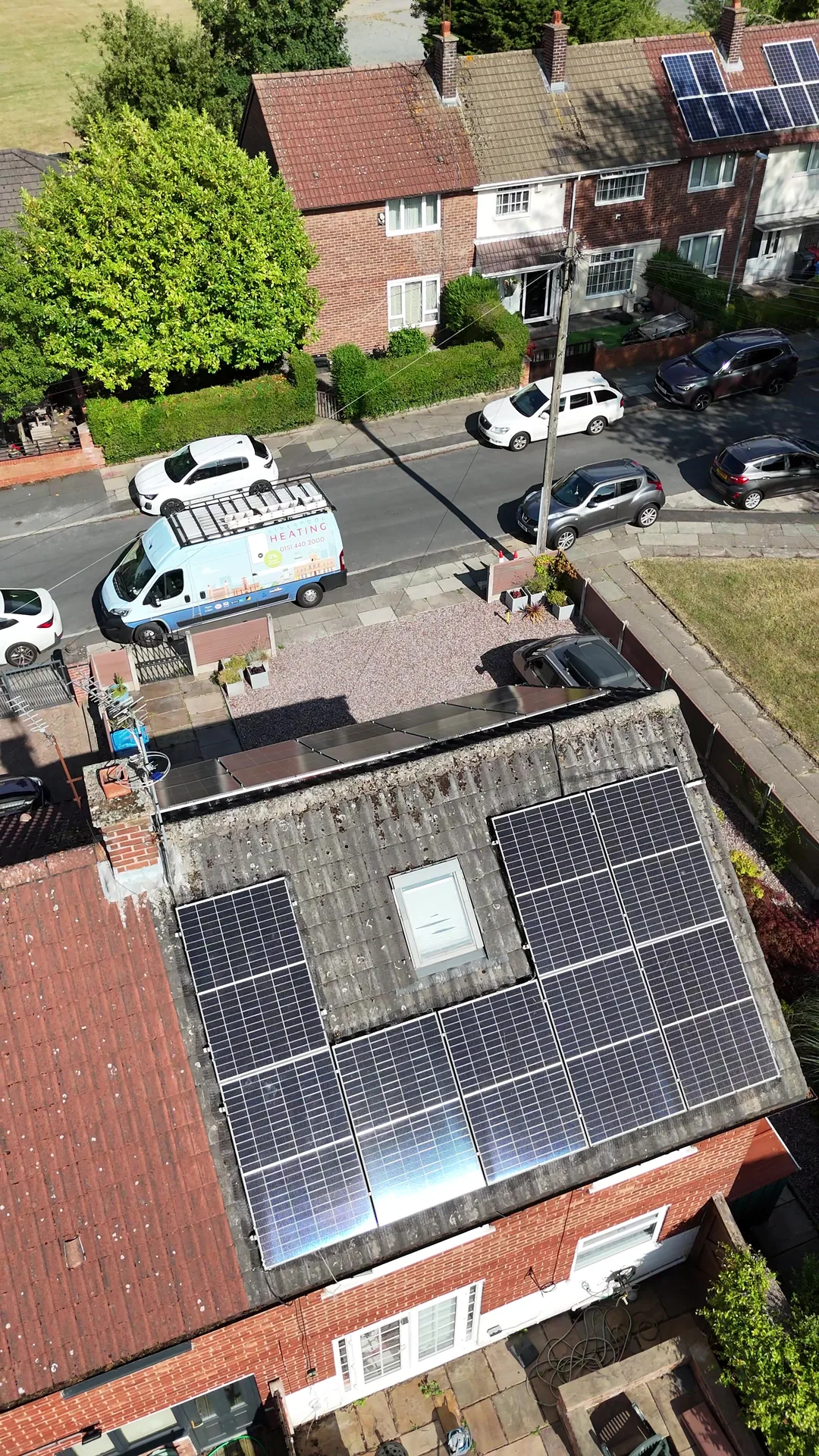
Common questions
Do I need planning permission for solar panels?
For most houses, no. Roof-mounted panels normally fall under permitted development, provided they project no more than 200 mm from the roof slope and sit no higher than the highest part of the roof, excluding the chimney. Panels cannot go on a scheduled monument, or on a building that sits within the grounds of a listed building — so a listed house and an unlisted building in its curtilage are both outside permitted development, and listed building consent is a separate requirement on top. In a conservation area you cannot fit panels to a wall fronting a highway. Parts of Liverpool, the Wirral and Sefton are conservation areas, so this is checked at survey rather than assumed.
Do I need planning permission for solar panels in a Liverpool conservation area?
Usually not for panels on the roof of a house, but there are limits. Liverpool City Council lists 36 conservation areas, around nine per cent of the city, including Woolton Village. In a conservation area panels cannot go on a wall fronting a highway, roof panels must project no more than 200 mm and sit below the highest part of the roof, and a listed building needs listed building consent. We check your property before quoting.
Will solar panels cut my gas bill?
No. Panels generate electricity, so they offset what you import from the grid, not what you burn in the boiler. Hot water is the one exception: if you have a cylinder rather than a combi, a solar diverter can push surplus generation into the immersion element and heat water the boiler would otherwise have heated. With a combi there is no store to divert into, so the saving is electricity only.
Do I need a battery, or can I add one later?
You do not need one, and plenty of systems work well without. A battery earns its keep if the house is empty during the day and you would otherwise export most of what you make, or if you want to use a cheap overnight tariff. You can add one later, and retrofit batteries also carry 0 per cent VAT until 31 March 2027, but say so at the outset so the inverter and the network application allow for it, because the battery inverter counts towards the 3.68 kW per phase threshold.
How much will the panels generate in winter?
Far less than in summer. The PVGIS model for a 4 kWp south-facing array in Liverpool puts May at roughly 506 kWh and December at roughly 116 kWh, under a quarter as much. Short days, a low sun angle and cloud all play a part. This is normal and it is designed around: judge a system on its annual figure, and expect a battery on an off-peak tariff to carry the winter evenings.
What happens when the roof needs re-tiling?
They come off and go back on, which is a cost worth avoiding. That is why roof condition and remaining life are assessed before anything is quoted. If the covering is close to the end of its life, repairing or replacing it first is almost always cheaper than paying twice for scaffolding, removal and refitting. On a sound roof, the mounting fixings are designed to stay weathertight for the life of the array.
How do I get paid for the electricity I export?
You apply to an energy supplier for a Smart Export Guarantee tariff; the payments are not automatic. You will need a smart meter that reports half-hourly export data, your export MPAN, and certification of the installation under MCS or Flexi-Orb, which is why export registration is handled through an MCS-certified installer. Your export supplier does not have to be your import supplier, though the best rates are usually reserved for import customers.
Ready for a warm, worry-free home?
Free, no-pressure quote from a local Gas Safe team — with 0% and 7.9% finance available.
Get your free quote
Tell us what you need and a member of our Gas Safe team will come back to you, usually the same day.
- Clear fixed prices, no hard sell
- 30 years keeping Merseyside warm
- Rather talk? Call 0151 440 2000